
OTET 2026 Notification: Eligibility, Dates & Complete Guide
The OTET 2026 notification is finally here. Get a clear, no-nonsense guide to what this exam is, who can apply, and how to prepare for a teaching career in Odisha.
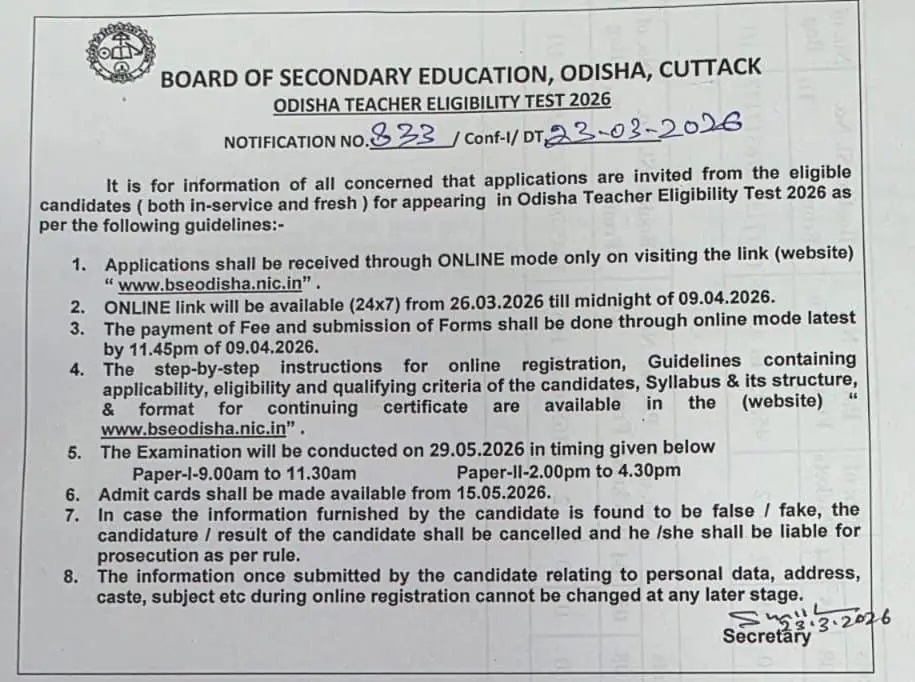
The OTET 2026 notification is finally here, and with it, a very real opportunity to step into a stable, respected teaching career in Odisha’s government schools. If you’ve been waiting for that one clear, no-nonsense guide to what this exam is, who can apply, and how to prepare—this is it.
What Is OTET, Really?
The Odisha Teacher Eligibility Test (OTET) is the state’s official qualifying exam for teaching Classes 1 to 8 in government schools. Think of it as your “eligibility passport” for applying to teaching posts—without it, you simply cannot be considered for most regular government school vacancies.
The exam is conducted by the Board of Secondary Education (BSE), Odisha, and is treated as a state-level eligibility test for teachers across primary and upper primary levels.
OTET 2026: Key Highlights at a Glance
Here’s the big picture in plain language:
- Exam Name: Odisha Teacher Eligibility Test (OTET) 2026
- Conducting Body: Board of Secondary Education (BSE), Odisha
- Purpose: To certify your eligibility to teach Classes 1–5 (Paper I) and Classes 6–8 (Paper II) in Odisha government schools
- Mode of Exam: Offline, OMR-based
- Duration: 2 hours 30 minutes per paper
- Total Marks: 150 per paper
- Negative Marking: None
If your dream is to enter a government classroom as a regular teacher one day, clearing OTET is your first compulsory checkpoint.
Important Dates You Can’t Afford to Miss
Treat these dates like deadlines for a job interview—because in many ways, that’s what they are.
- Application Window Opens: March 26, 2026
- Application Deadline: April 9, 2026 (up to 11 PM)
- Admit Card Release: May 15, 2026
- OTET 2026 Exam Date: May 29, 2026
Mark them on your calendar, set phone reminders, and if needed, put a sticky note on your study table. Missing even one deadline means waiting an entire year.
👥 Who Can Apply: Basic Eligibility
Before rushing to fill the form, pause and make sure you actually qualify.
- Domicile Requirement: You must be a permanent resident of Odisha.
- Exam Options:
- Paper I – for teaching Classes 1–5 (Primary)
- Paper II – for teaching Classes 6–8 (Upper Primary)
- You can apply for either one or both, depending on your qualifications.
The good news? There is no upper age limit. As long as you meet the educational criteria, your age will not hold you back.
Eligibility for Paper I (Classes 1–5)
You are eligible for Paper I if you fulfill any of the following routes:
-
Route 1:
- Higher Secondary (+2) with at least 50% marks (45% for SC/ST/SEBC/PH)
- Plus a 2-year Diploma in Elementary Education (D.El.Ed/CT)
-
Route 2:
- Graduation in any stream
- Plus a 2-year D.El.Ed/CT
In simple words: if you have +2 with good marks and D.El.Ed, or you’re a graduate with D.El.Ed, you’re cleared for Paper I.
Eligibility for Paper II (Classes 6–8)
You are eligible for Paper II if you meet any of these:
-
Route 1:
- A Graduation degree with at least 50% marks
- Plus a B.Ed
-
Route 2 (Integrated Course):
- Higher Secondary (+2)
- Plus a 4-year integrated B.A. Ed. or B.Sc. Ed.
In short: for upper primary, you need a strong combination of graduation-level education and professional teacher training (B.Ed or integrated B.A./B.Sc. Ed.).
Exam Pattern: What the OTET Actually Tests
Both Paper I and Paper II follow a very structured pattern:
- Mode: Offline (OMR sheet)
- Duration: 2 hours 30 minutes
- Total Questions: 150
- Question Type: Multiple Choice Questions (MCQs)
- Marks per Question: 1
- Negative Marking: None
That “no negative marking” point is huge. It means you should never leave a question blank—educated guesses are absolutely worth it.
📝 Paper I Structure (Primary Level: Classes 1–5)
Paper I focuses on the foundational skills you’ll need to handle young learners:
-
Child Development & Pedagogy – 30 Marks
How children think, learn, behave, and respond in a classroom setting. This is the psychological backbone of your teaching. -
Language I – 30 Marks
You choose from: Odia, Hindi, Telugu, Urdu, or Bengali.
This checks your command over the medium of instruction. -
Language II (English) – 30 Marks
Compulsory for everyone. Tests comprehension, grammar, and basic usage. -
Mathematics – 30 Marks
-
Environmental Studies – 30 Marks
Together, Maths and EVS make up the subject-specific 60 marks for Paper I.
📝 Paper II Structure (Upper Primary: Classes 6–8)
Paper II is slightly more specialized because it expects you to be stronger in a particular subject group:
- Child Development & Pedagogy – 30 Marks
- Language I – 30 Marks (Odia/Hindi/Telugu/Urdu/Bengali)
- Language II (English) – 30 Marks
For the 60-mark subject-specific section, you have to choose one of the following combinations:
- Mathematics & Science (for candidates who want to teach these subjects), or
- Social Studies (for those aiming at Social Science teaching)
If you know which subject you want to handle in school, your choice here should align with that.
Marking Scheme: How Your Performance Is Counted
- Correct Answer: +1 mark
- Wrong Answer: 0 (no negative marking)
- Unattempted Question: 0
Because there is no penalty for wrong answers, your strategy should be:
- Never leave a question blank.
- Eliminate obviously wrong options.
- Make an informed guess if you’re stuck.
How to Apply for OTET 2026
The application process for OTET 2026 is conducted entirely online through the official BSE Odisha portal. To ensure you don't make any mistakes that could lead to rejection, we have created a separate, detailed walkthrough of the entire process.
👉 Read our Complete Step-by-Step OTET 2026 Application Guide for a clear explanation of registration, document uploads, and fee payment.
A Practical Study Game Plan
If I were preparing for OTET 2026, here’s exactly how I’d structure my preparation:
1. Start with Child Development & Pedagogy
- It carries 30 marks on its own, but its concepts—how children learn, think, and behave—feed into every other subject.
- Understanding theories of learning, motivation, inclusive education, and classroom management will strengthen your answers across the paper.
In many ways, pedagogy is the “central nervous system” of the exam.
2. Respect the Language Sections (Especially English)
Many candidates focus only on Maths, EVS, or Social Studies and assume they’ll “manage” Languages. That’s a big mistake.
- Language I tests your comfort in the regional/medium language.
- Language II (English) often becomes a silent rank-decider—those who score well here gain an easy edge over the rest.
Give at least a fixed slot every day to reading, basic grammar practice, and comprehension exercises.
3. Build Conceptual Clarity in Subject Areas
For Paper I:
- Focus on basic arithmetic, word problems, and logical thinking in Maths.
- In EVS, emphasize everyday life, environment, family, community, and basic science concepts.
For Paper II:
- If you choose Math & Science, revise NCERT-style school-level concepts thoroughly and understand how to teach them, not just solve them.
- If you choose Social Studies, sharpen your understanding of History, Geography, and Civics along with their classroom applications.
4. Solve Past 5 Years’ OTET Papers
This single habit can dramatically improve your score:
- You’ll understand question patterns and recurring topics.
- You’ll develop a sense of time management.
- You’ll automatically learn which areas you must strengthen.
Try to simulate exam conditions—fixed time, no interruptions, and strict adherence to the pattern.
5. Practice with OMR or Bubble Sheets
Since the exam is OMR-based, your performance is not just about knowledge but also about marking answers cleanly and quickly.
- Practice filling bubbles on sample OMR sheets.
- Train your eyes and hands to move smoothly from question booklet to answer sheet.
This reduces silly mistakes like marking the wrong question number.
Mindset Matters: How to Stay Ahead
Beyond the books and mock tests, a few mindset shifts can help you:
- Start early: You already know the exam date. Don’t wait for “perfect time.” Start now, even with 1–2 focused hours a day.
- Be consistent: Short, daily study blocks beat long, irregular sessions.
- Avoid comparison: Everyone’s journey is different. Focus on improving your own score, not someone else’s.
- Treat OTET as a beginning, not the end: This is your eligibility ticket. The real journey—interviews, postings, growth in service—will follow.
Final Thoughts
OTET 2026 is not just another exam notification; it’s a doorway to your future classroom, your future students, and the career you’ve been preparing for. The competition will be real, no doubt—but so is your chance.
If you plan smart, start early, and stick to a disciplined routine—focusing on pedagogy, language skills, and past papers—you give yourself a very fair shot at clearing OTET and moving one big step closer to your teaching dream.
Ready to apply for OTET 2026?
Free, fast, and secure online tool. No registration required.